Most indie authors recruit an ARC team the same way. One post to the newsletter, a call in a Facebook group, a link in the back matter, and then a sinking feeling six weeks later when it turns out that of the 80 people who raised their hands, 9 posted a review.
That's usually not a recruiting problem. It's a filtering problem, and filtering is what a funnel does.
Before any advice: the numbers you'll see quoted here are shakier than they look. The common claim that 20 to 40 percent of ARC readers post a review traces to author blogs, not to any study. The one measured figure comes from BookSirens, which says about 75 percent of readers who download through its marketplace review the book, but that's a vendor reporting on its own vetted pool. Use both as orientation and measure your own.
Define a qualified reader first
Every funnel gets designed backward from its output, so write down what a qualified reader looks like for this book before you write a single email.
They read your genre voluntarily. A thriller reader who takes a free copy of your quiet literary novel will leave two stars complaining about pacing. They have somewhere to post, meaning an active account on Amazon, Goodreads, StoryGraph, BookBub, a blog, or TikTok. They've reviewed before, because past behavior is the best predictor available. And they have room in the calendar to finish a book and post inside your window.
Those four become your form questions, your scoring rubric, and half your email copy.
Settle size early too. Twenty to fifty is normal for a debut, fifty to a hundred once you have a readership. Recruiting 300 people you can't service or personally thank produces fewer reviews than 40 who feel chosen.
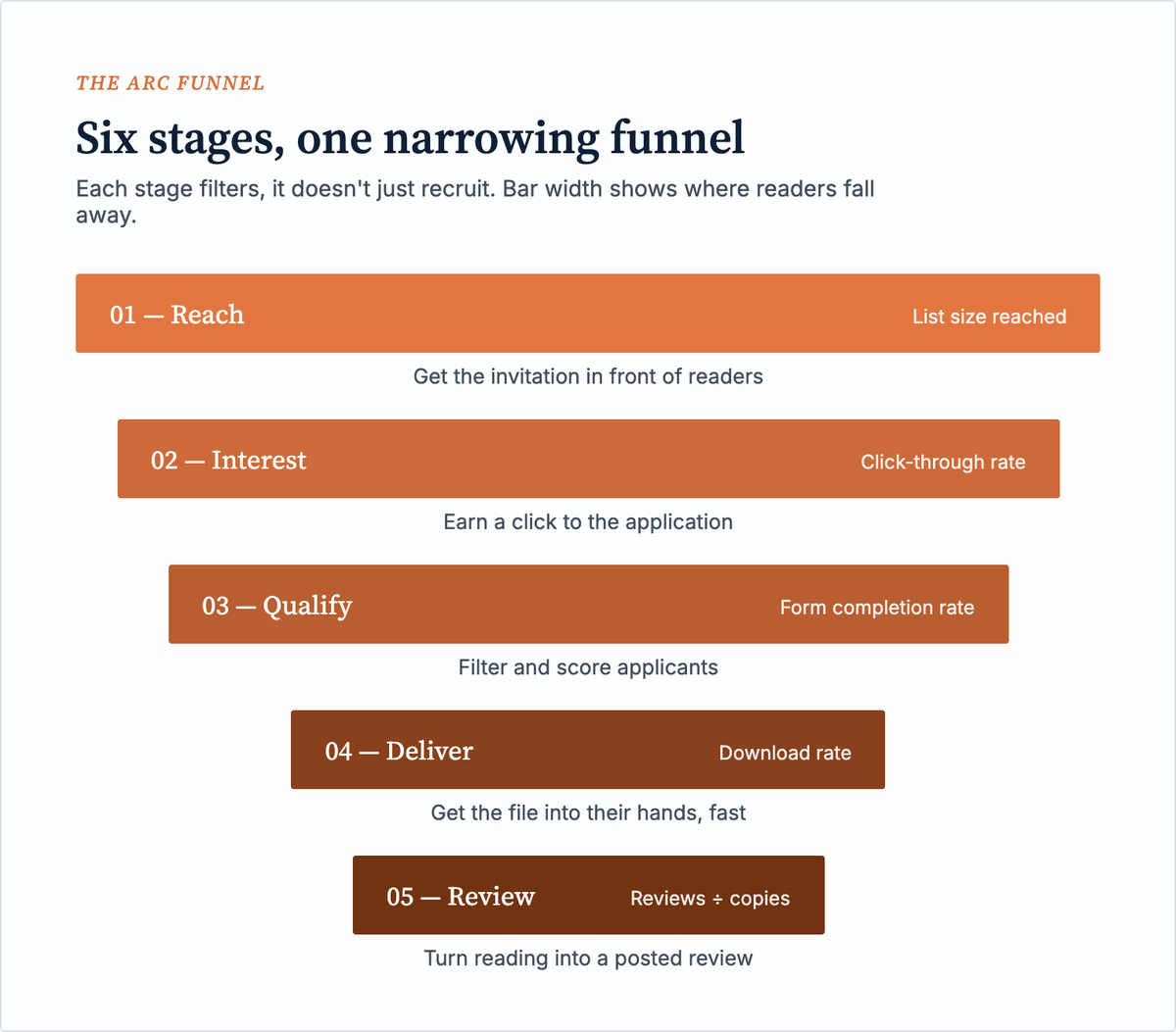
The stage most authors underestimate is Deliver. A file that doesn't open, or arrives in a format the reader can't sideload, quietly costs you a review that was otherwise coming. Watch the download rate, not just the sign-up count.
Reach and the invitation
Your existing list is the best source of ARC readers you'll ever have. Start there, then add back matter in your published books ("want to read book three before anyone else?" pointed at an evergreen page, not a dated campaign), your genre's actual gathering places, and newsletter swaps with authors who write what you write. Invite last book's reviewers first, by name, before the general call goes out.
Start recruiting about six months before launch and get copies out at least three months ahead. Reviewers with real audiences plan their reading weeks in advance.
The invitation is one email with one job: earn a click. For scale, Brevo's 2026 data puts media-sector open rates at 21.29 percent and click-through at 3.01 percent. A warm author list should beat that, and if yours doesn't, list hygiene is the problem to fix first.
Open with the actual premise, not "my new book is coming." State the ask plainly. Then say the qualifications out loud: "if you read [genre] regularly and post reviews on Amazon, Goodreads, or StoryGraph, this is for you." Naming criteria in the email pre-filters the click. Close with honest terms, a deadline, and one button.
The application form Cabins Press builds for you
You'll read that multi-step forms convert dramatically better than single-page ones. The figures behind that claim (86 percent, three times, 300 percent) come from vendor pages and unaudited case studies, and HubSpot's analysis of 40,000+ landing pages found conversion drops only slightly as fields increase. Split the form anyway, for two reasons that survive the disputed stats. Name and email on their own first screen means you keep the lead when someone abandons later. And sequencing puts the terms last, after several minutes of investment, where people actually read them.
That's the shape the Cabins Press ARC form ships in: contact info first, your qualifying questions in the middle, terms and disclosure last. It lives at your own URL (cabinspress.com/authors/<you>/arc/<book>, or /books/<book>/arc on a custom domain), on a page carrying your cover and your campaign copy rather than a Google Form's.
The middle section is yours to build. Add whatever tells you a reader is right for this book, whether that's a comparable-titles checklist, "what's the last book in this genre you loved?", or where they post and a profile link. Mark a question reusable and it carries into the next campaign instead of being rebuilt.
Two things a spreadsheet can't do. Set a reader cap once and the form closes itself the moment you hit it, rather than you noticing forty responses too late. And because confirmations route through the campaign's own delivery pipeline, a hard bounce gets flagged instead of sitting in your numbers as a live signup forever.
One thing not to add: a checkbox requiring a review in exchange for the copy. Amazon permits free copies "as long as you do not require a review in exchange," and a mandatory promise on the form is that same condition relocated. State the hope in the form's description field instead. Keep the steps short, check it on a phone, and set a real deadline.
The five-email sequence
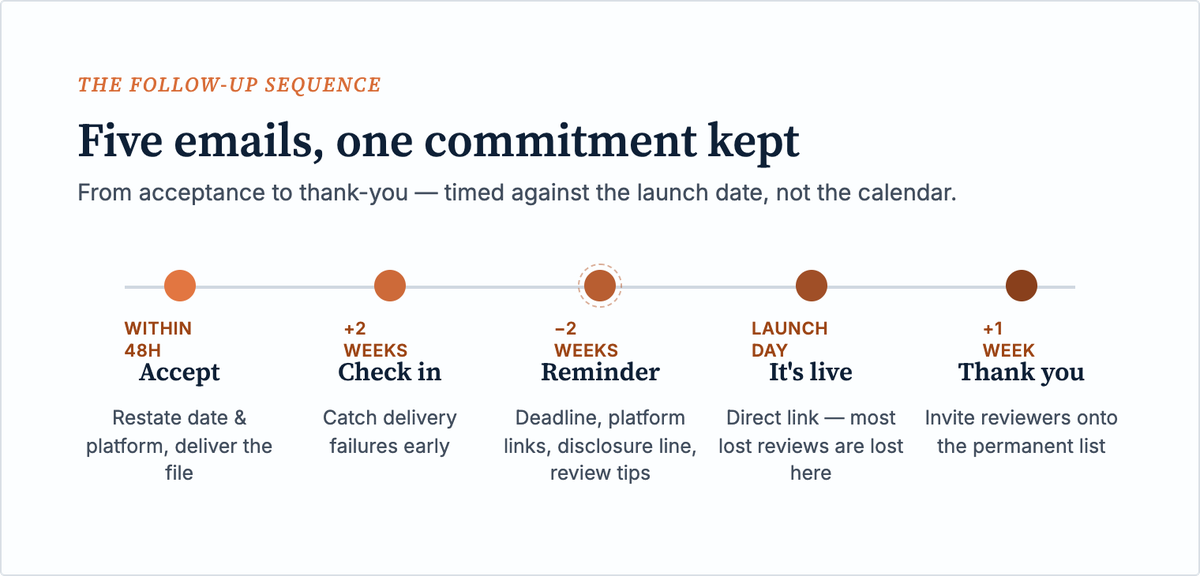
Accept within 48 hours of your deadline, restating the date and platform and delivering the file. Enthusiasm decays fast. Decline everyone else courteously and offer them something, because declined applicants are still among your most engaged readers.
Check in lightly at two weeks to catch delivery failures while there's time to fix them. Two weeks before launch, send the reminder that does the real work: deadline, direct links to each review platform, a disclosure line they can copy, and a note on what makes a helpful review. On launch day, "it's live, here's the link." Most lost reviews are lost right here, to friction. A week after, thank the team and invite the people who posted onto the permanent list.
Four numbers
Record click-through on the invitation, form completion (Zuko's 2026 average is 66 percent of forms started), download rate (under 90 percent is a technical problem, not a reader problem), and review conversion. Since there's no trustworthy public benchmark for that last one, your first campaign is the benchmark. Fix the worst number before the next launch, not all four at once.
By book three, recruiting is mostly emailing the people who delivered last time and topping up the difference. You're not finding 50 readers for this book. You're building the thing that finds them for the next four.
Next: the rules that govern all of this are narrower and stranger than the advice suggests. See what Amazon and the FTC actually require.
Sources
- Brevo, Email Marketing Benchmarks 2026
- HubSpot, which form fields lower landing page conversions
- Venture Harbour, how form length impacts conversion rates
- WPForms, what's a good form conversion rate, Zuko 2026 figures
- BookSirens pricing, source of the 75 percent claim
- Write Publish Sell, What Is an ARC Team? (2026), source of the 20 to 40 percent figure